
INTERNAL MARTIAL ARTS
Internal Martial Arts distinguish themselves from ”external” styles – boxing, karate, muay thai, Shaolin boxing, etc. – in that the main emphasis is to minimise the extent to which one relies on muscle tension to generate movement, speed, endurance and power, and instead one relies more on an integration of your whole body as a tensegrity structure, similar to what many animals have naturally, particularly cats.
This is accomplished by adhering to unique Qi Gong principles of postural alignment, breath control, body mechanics and mental concentration, to maximise output whilst minimising physical effort.
However, this does not mean that Internal training is less demanding, as it is actually quite the opposite. A big focus in Qigong training is stationary “Standing Stake” 站樁 meditation, which is serves as the foundational tool to align your body and still your mind as you endure the process of muscular tension transferring onto your sinews.
More importantly, authentic martial arts are not just about learning how to fight, but just as importantly, learning how to stop a fight, while also avoiding personal injury – accomplished through the regular practice of two-person exercises in the form of ‘pushing hands’ 推手 Tuī Shǒu, which develop the ability to manage force whilst under stress.
Adjusting your posture out of habit minimises any unnecessary pressure and strain on your joints, organs, nerve pathways, blood vessels, glands, etc. and therefore more of your whole body can be engaged on exertion with less effort.
Adjusting your breath increases the amount of oxygen available for organ, glandular & ultimately cellular functioning, as well as decreasing the strain on your heart, consequently allowing your mind to settle and being much less distracted by mental & emotional stimulation, granting you more clarity in your decision-making, whether in self-defence or, more realistically, in life.
One is therefore able to engage life’s challenges more calmly whilst maintaining a sense of self-control = an invaluable skill to be able to rely on as we continue to walk life’s often unpredictable path.
“The systems of Xíng Yì Quán “”Form & Mind Boxing”, & Tài Jí Quán “”Grand Ultimate Boxing” and Ba Gua Zhang “Eight Trigram Palm” serve as very accessible, effective & safe tools to gain an ever-increasing sense of self by nurturing the most precious gift of all = one’s health.
show less ↑
CLASS SCHEDULE
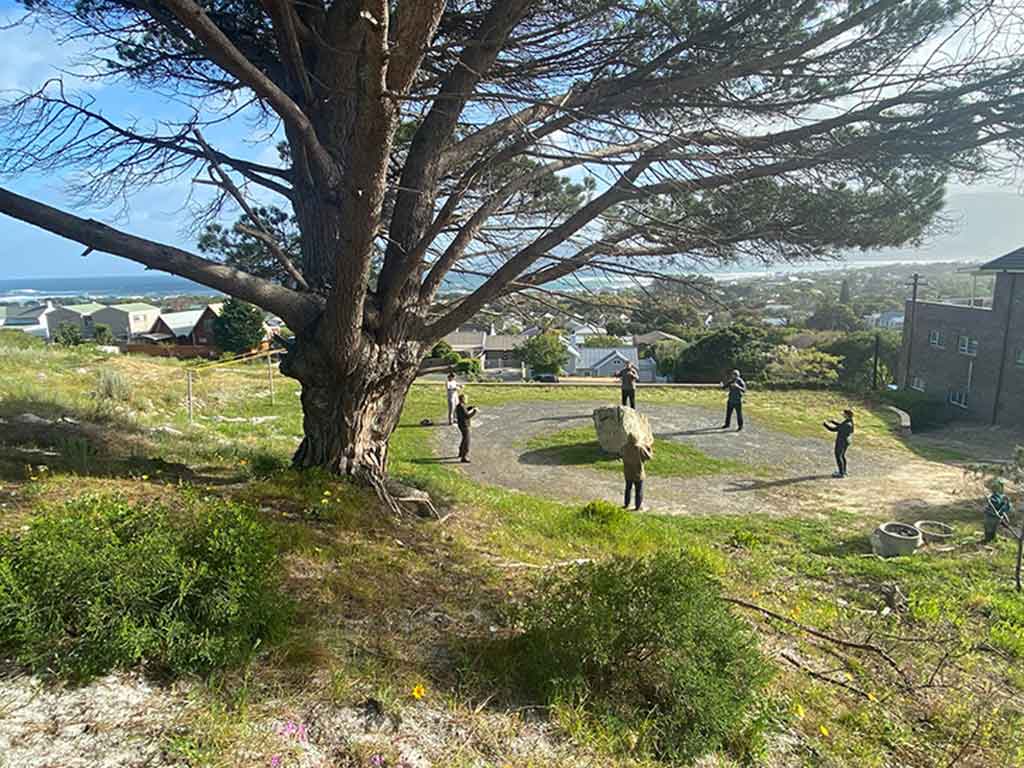
Thomas currently teaches group classes twice per week. Private one-on-one sessions are also available by appointment. Workshops will be announced here and on social media platforms. Whether you are a beginner or a seasoned practitioner, this approach to cultivating yourself and your body will have something for you.
All classes begin with a set of warming up, loosening, and stretching exercises to open the body. Followed by sensitisation exercises to activate your higher senses, then Standing Stake and movement meditation to further open up space within. We then go into a variety of two-person exercises to challenge and strengthen your sense of balance.
Class atmosphere is very relaxed, with questions welcomed and encouraged throughout the session.
WHAT TO EXPECT
The classes are very mental = you’ll be exposed to a lot of information to give you the tools to continue more and more independently over time. They are also very dynamic, so your joints and your physiology WILL be affected, which is the point. And, the sessions are very physical, as you will be interacting with other participants’ bodies through partner training such as the Push Hands exercises, to learn how to better manage force.
WEDNESDAY 8AM – 9:30 AM
St Joseph’s Church, Kommetjie
Qi Gong / Push hands (all levels)
THURSDAY 7AM – 8:30 AM
The Labia, Gardens
Qi Gong / Push hands (all levels)
👗Wear comfortable, loose clothing and flat-soled footwear. Bring a towel and water to rehydrate.
💰 Cost: R150 cash / 90 min session
☎️ Contact Thomas +27 079 517 8544 for more info or to be added to the Qi Gong WhatsApp groups.
Tai-Ji Wu Family
108 Posture sequence intro
This is a demonstration of the intro of the Wu-Family form at increased speed to develop a tighter relationship amongst physical alignment and body mechanics, breath control and intent.
NEIGong
Styles Trained
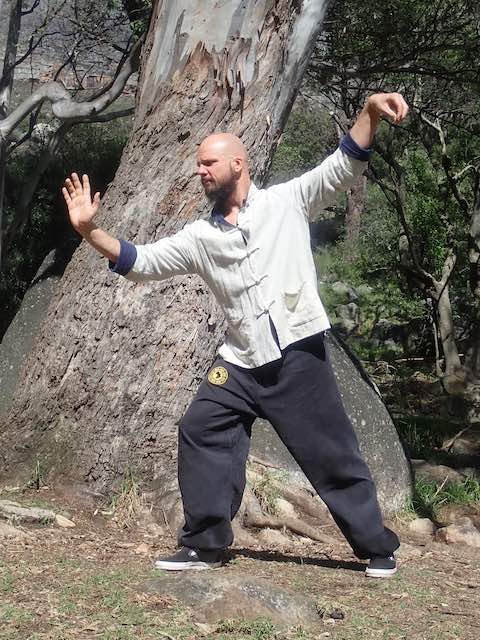
The Internal Martial Artist enriches their practice with specific physical, energetic and mental exercises to develop certain qualities of sensitivity and power, all of which are based on the phenomenon of ‘release’ inside the body. Dr Thomas Jahn trains and teaches the styles listed below. Each shares in many of the same principles, yet will differ in how they are applied within each style. Fundamentally all of these styles work to centralise and mobilise forces within you.
From another perspective, Taiji is said to dissolve the centre, Xingyi fortifies it, and Bagua moves it.
QI GONG
太極拳
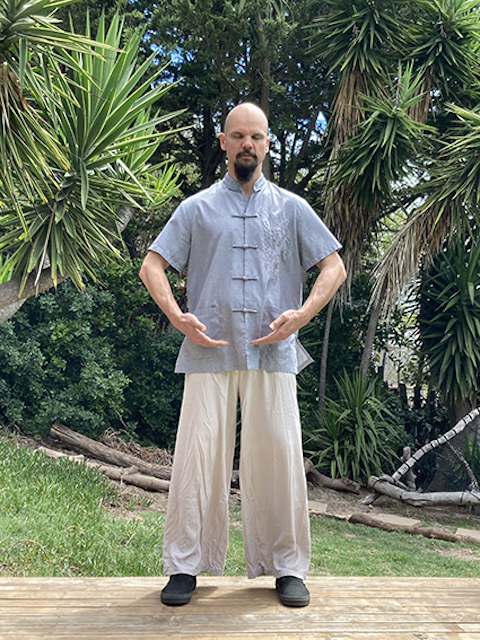
Qi Gong is an ancient system of stationary and dynamic therapeutic health- and strength-enhancing exercises that enable you, as the practitioner, to contribute to an unobstructed flow of Qi/vitality throughout the entire body – a prerequisite to proper physical, functional, emotional, mental and spiritual health and well-being.
TAI JI QUAN
太極拳
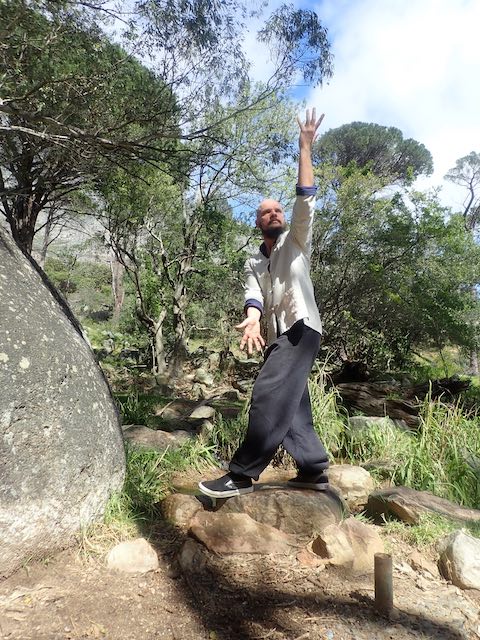
‘Great Ultimate Boxing’, known for its often slow movement sequences, Tai-Ji emphasises activating, maintaining and further developing the ‘released state’ while progressing through the movements of a form, to build the ‘Taiji Body”.
XING YI QUAN
形意拳
‘Form Mind Boxing’ uses the ‘trinity posture’ – a power-building standing meditation exercise that requires displacing one’s body weight predominantly over one leg at a time, to develop a solid foundation in the legs, waist and spine. From this foundation one trains Five Element Boxing – a unique set of stepping sequences that further develop whole-body coordination with subsequent increases in stability and power.
BA GUA ZHANG
八卦掌
‘Eight Trigram Palm’, relies on ‘circle walking’ training, where one walks along a curve around a central stationary point like a pole or a tree. Initially, this is done whilst holding the arms and hands in unique postures called ‘Mother Palms’, followed by training the ‘Palm Changes’. Ba Gua is physically a more demanding system to train, as progressively all of one’s joints are integrated to be moved along a curve, and eventually along spiralling vectors.
PUSH HANDS
推手
Push Hands is a two-person exercise that promotes the very same principles that apply to Qi Gong and internal Martial Arts. One has contact either with one or two arms of one’s training partner, then through a variety of initially choreographed, then more reflexive movement sequences, the focus is to challenge the state of ‘release’ of one’s body and that of one’s training partner. This is developed by constantly attempting to avoid directly resisting the attempts of the other person to control you physically, and instead to yield to the others force for the sake of gaining control over it.
Herein lies the essence of the practice – settling our innate confrontational nature, to function more to our full potential.
The push hands exercises are also a kind of doorway to discover how to apply the practical applications inherent to the particular art you are currently training. This helps to develop the appropriate placement, speed, timing and force to learn how to more safely and successfully develop your skill, all the while building up more confidence.
GALLERY
Student resources
站樁
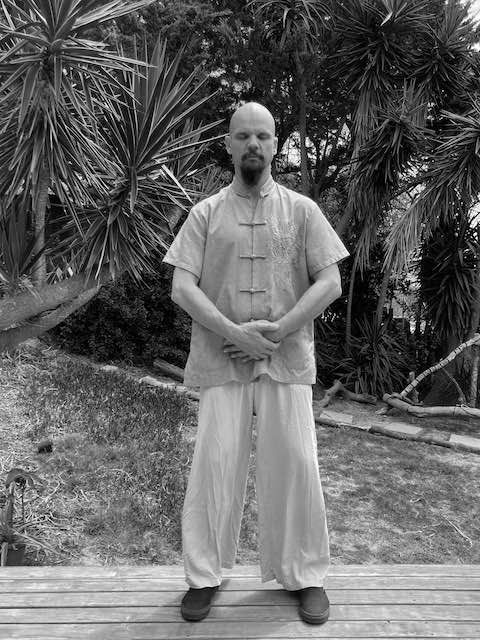
standing stake
In this system of Qigong, the feet are shoulder width apart, knees gently bent, spine stretched open and initially hands placed loosely over the relaxed abdomen to guide breath and mental concentration into it. This sets up the foundational conditions that are conducive to promoting the self-regulating functions of the body = health-promoting aspect, and serve as a prerequisite to enable you to connect your body up as a dynamic tensegrity structure = physical strength-promoting aspect.
Each of the eight postures of these “Standing Stake Meditation” exercises uniquely challenges your ability to regulate your posture, breath and concentration to continue to strengthen all three.
推手.
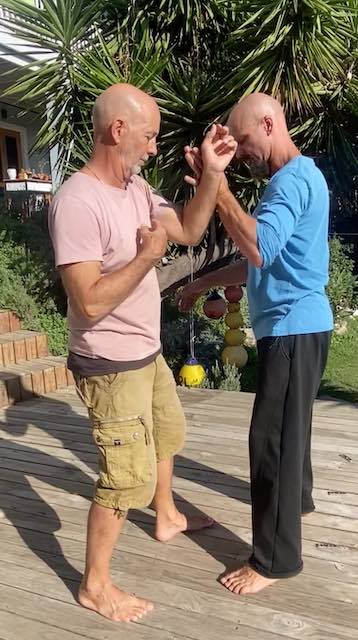
push hands
In this one-handed push hands partner drill, the purpose is to develop whole body connection with the ground and your partner, and use the consequent sensitivity and strength to train very effective self-defence and martial applications. In this exercise, one alternates between left and right hand, to then eventually go into two-hand push hands routines.
動功
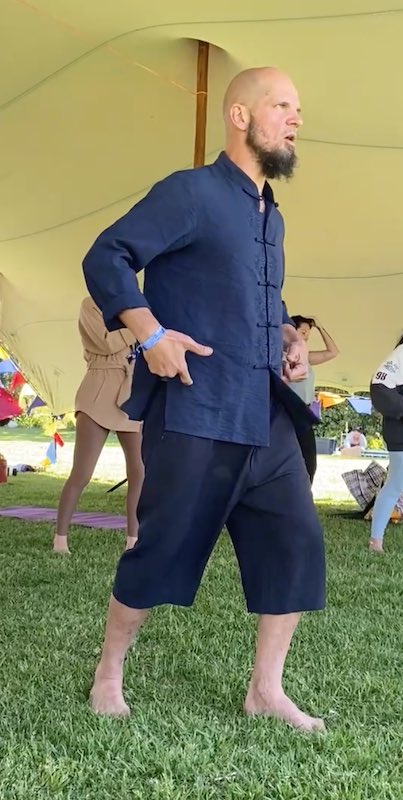
movement meditation
Dr Thomas Jahn explains the placement of the body and movement of the legs and hips that underpin the basic body mechanics for internal martial arts practice. “Dong Gong 動功” or “movement skill” exercises are a kind of movement meditation that emphasises the same postural principles that apply to the stationary practices. When practicing these exercises, a major focus is to rediscover these principles within self whilst in a state of movement, and on a more advanced level, whilst under stress from a training partner. This is a secure way to actually be able to apply this principles practically, and learn how to increase your power whilst doing so.
Any questions about treatments or bookings?
Please WhatsApp 066 490 4382 or send a mail to contact@drthomasjahn.co.za